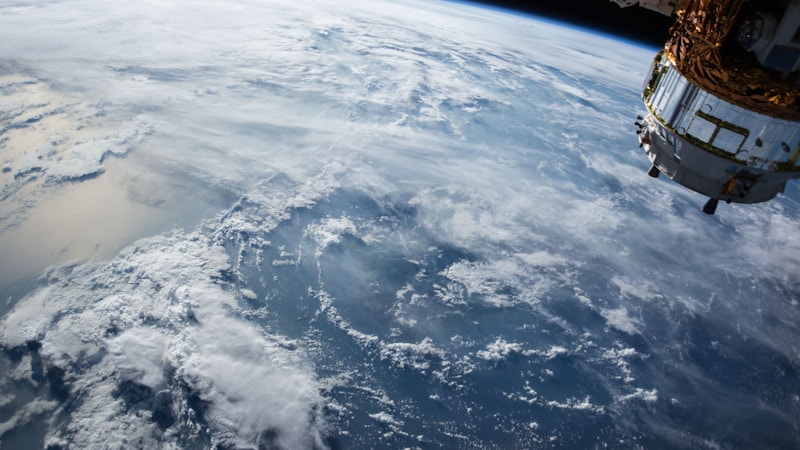
There is a particular quality of awe that only the universe can produce. The distances are so vast, the timescales so incomprehensible, the phenomena so violent and beautiful and indifferent to human concerns that confronting them honestly requires a recalibration of the self. The best books about space and astronomy do not simply convey facts. They transmit a sense of scale — the vertiginous, humbling recognition of where we are and what we are. They also tell some of the most dramatic human stories ever recorded: the Cold War race to orbit, the engineers who built machines capable of leaving the solar system, the astronomers who decoded the light of dead stars. The books gathered here represent both traditions at their best.
The works that defined popular astronomy writing
Cosmos (1980) by Carl Sagan remains the benchmark against which all subsequent popular science writing is measured. Sagan was a Caltech and Cornell astronomer of genuine distinction, but his real gift was rhetoric — the ability to make a reader feel, in their body, the weight of cosmic time and space. The opening sentence — “The cosmos is all that is or was or ever will be” — sets the tone: grandeur without mystification, wonder without condescension. Sagan moves from the big bang through the formation of stars and planets to the origin of life, the history of astronomy as a human enterprise, and the possibility of other civilizations in the universe. His chapter on the Library of Alexandria, in which he mourns the destruction of ancient knowledge as a civilizational catastrophe, has made readers weep for two generations. The book was written to accompany the PBS television series of the same name, but it far outlasted the series. If you read only one book about the universe, this is it.
A Brief History of Time (1988) by Stephen Hawking sold more than ten million copies in its first two decades, making it one of the best-selling popular science books ever published. Hawking set himself the task of explaining the structure of space and time — including black holes, the big bang, the nature of singularities, and the theoretical frameworks physicists use to describe them — without using a single equation. Whether he entirely succeeded is debated: the book has a reputation for being widely purchased and less widely finished. But the parts that land, land with genuine force. Hawking’s explanation of how black holes can emit radiation (the phenomenon now called Hawking radiation) communicates the strangeness of quantum mechanics at the event horizon in terms that genuinely illuminate. And the book’s final pages, in which Hawking asks what it would mean to achieve a “complete theory” of the universe, contain some of the most ambitious scientific writing of the twentieth century.
On the human drama of space exploration
The Right Stuff (1979) by Tom Wolfe is a masterpiece of literary journalism and one of the finest accounts of twentieth-century American ambition ever written. Wolfe reconstructs the early years of American spaceflight — from the test pilots at Edwards Air Force Base who first broke the sound barrier to the original Mercury Seven astronauts — with his characteristic baroque prose and his characteristic eye for the absurd. His central argument is that the astronauts were selected and celebrated not primarily because they were brilliant scientists but because they possessed an indefinable quality — the “right stuff” — that was part courage, part recklessness, part performance of a particular masculine ideal. The astronauts themselves were not uniformly pleased with his portrait. Chuck Yeager, whom Wolfe elevates as the platonic ideal of the type, never became an astronaut; the book suggests the bureaucratic machinery of NASA could not accommodate his brand of pure individualism. It is a story about heroism, celebrity, and institutional culture that remains as readable and as prescient as it was when first published.
Carrying the Fire: An Astronaut’s Journeys (1974) by Michael Collins is the memoir that astronauts themselves most often cite as the best ever written by one of their number. Collins was the command module pilot on Apollo 11 — the mission that landed Neil Armstrong and Buzz Aldrin on the Moon while Collins orbited alone above. He spent nearly an hour on the far side of the Moon, completely cut off from all human contact, the most isolated human being in history. His account of that experience, and of the entire journey from Air Force test pilot through Gemini and Apollo, combines technical precision with literary grace and an appealing self-awareness. Collins writes without the self-aggrandizement that mars many astronaut memoirs, and his description of watching the Earth recede from the window of Apollo 11 is one of the most quietly profound passages in all of space literature.
The universe explained at every scale
Astrophysics for People in a Hurry (2017) by Neil deGrasse Tyson is a compact, accessible introduction to the major concepts of modern astrophysics: dark matter, dark energy, the big bang, the expanding universe, the electromagnetic spectrum, and the chemical origins of life. Tyson writes with a gift for analogy — he is perhaps the most naturally gifted science communicator of his generation — and the book delivers genuine conceptual content in prose that is both clear and entertaining. It is not a deep dive into any single topic, but as an orientation to the largest questions physicists currently grapple with, it is difficult to improve on. The chapter on dark matter, in which Tyson explains that the matter we can see and measure constitutes only about five percent of the universe’s total content, is a reminder that the most fundamental questions about the cosmos remain unanswered.
The Elegant Universe (1999) by Brian Greene takes on one of the most audacious projects in popular science writing: explaining string theory to a general audience. String theory proposes that the fundamental constituents of reality are not particles but one-dimensional vibrating strings of energy, and that their different vibrational modes correspond to the different particles physicists observe. Greene’s achievement is to make this genuinely difficult mathematics legible through sustained analogy and visual imagination. The later sections, which concern extra dimensions and the landscape of possible universes, stretch the analogy further than some readers will find comfortable. But Greene’s fundamental argument — that the quest for a unified theory of the very large and the very small is the central intellectual adventure of our time — is compellingly made.
On the search for life beyond Earth
The Demon-Haunted World: Science as a Candle in the Dark (1995) by Carl Sagan is, among its other virtues, one of the most thorough and compassionate debunkings of the belief in alien abduction ever written. Sagan takes the phenomenon seriously as a psychological and cultural one — why do so many people, in so many countries, have such vivid and consistent experiences of being taken by extraterrestrial beings? — while remaining rigorously skeptical about the claims themselves. But the book is much broader than that: it is a defense of scientific thinking as a habit of mind, and an argument that the methods of science — evidence, hypothesis, experiment, skeptical review — are the best tools humanity has developed for distinguishing what is true from what we wish were true. In an era of rampant misinformation, its central argument feels more urgent than ever.
The Search for Life in the Universe by David Goldsmith and Tobias Owen is a more technical but enormously rewarding survey of the field now called astrobiology: the scientific study of the possibility of life elsewhere in the cosmos. The authors cover the chemistry of life’s origins, the conditions required for liquid water, the search for biosignatures on Mars and in the atmospheres of exoplanets, and the ongoing SETI efforts to detect signals from intelligent civilizations. It is not a book for readers who want to be told that extraterrestrial life has been found — it has not — but for readers who want to understand why the question is scientifically serious and what the search actually involves, it remains one of the most thorough treatments available.
Making the cosmos personal
An Astronaut’s Guide to Life on Earth (2013) by Chris Hadfield is, on its surface, a memoir of the Canadian astronaut’s career, culminating in his command of the International Space Station in 2012–2013. But Hadfield frames the book as a series of practical lessons drawn from his experience: how to prepare for worst-case scenarios, how to find meaning in tedious and repetitive work, how to manage fear, how to be a useful member of a team whose members’ lives depend on each other. The ISS chapters — in which Hadfield describes the daily reality of living and working in orbit, including the famous YouTube video of him performing David Bowie’s “Space Oddity” that made him briefly the most famous person in space — are vivid and often funny. But what makes the book worth returning to is the quality of attention Hadfield brings to his experience: a mind trained to observe precisely, and a writer willing to share what that observation actually reveals.
How to build a reading life around space and astronomy
Space and astronomy books span an enormous range of difficulty and approach. Carl Sagan and Neil deGrasse Tyson offer entry points accessible to any reader; Brian Greene and Stephen Hawking demand more sustained attention; technical surveys of astrobiology or cosmology reward readers with scientific backgrounds. The best approach is to follow your own curiosity: if the question of life elsewhere in the cosmos obsesses you, start with Sagan’s The Demon-Haunted World and follow it with the astrobiology literature. If the human drama of spaceflight moves you, begin with Tom Wolfe and Michael Collins.
Tracking your reading across this genre with an app like Bookdot helps you map the connections between books and plan a coherent journey through the subject. Space writing is one of those domains where reading widely — mixing memoir, narrative nonfiction, and popular science — builds a richer picture than any single approach could provide alone. The universe, as Sagan never tired of reminding us, is far stranger and far more interesting than anything we could have invented.